TAGTHAi Digital Transformation Project:
Developed TAGTHAi’s value proposition and community criteria to foster sustainable tourism in Thailand, applying business frameworks to align community growth with company goals that ensures long-term impact.

Building Social Enterprise Business Model
Project Overview
TAGTHAi's Social Enterprise Model Project focuses on building a new business model that create sustainable tourism in Thailand, improving the community structure and uniqueness, by developing skills and staff of the community, simultaneously, creating values and income to the company.
In this project, I have come up with TAGTHAi Value Proposition that would benefit the collaboration between TAGTHAi and the community. The criteria of joining community have been set to define the standards and foundation whether each community will be suitable with TAGTHAi end goals.
Global, prominent business frameworks are used to apply for the projects, in order to create the right direction of the business goals, which can build a sustainable, successful community-based tourism.
Product
Social Enterprise
Business Model
Role
Strategy & Product Manager
Researcher
Duration
2 months (Discovery Phase)
Responsibility
-
Researched & developed the social enterprise business model which is a collaboration of KBANK, TAGTHAi, & Tourism Authority of Thailand (TAT) to develop a sustainable business, helping solve social & environmental issues, meanwhile, identifying market potential for revenue stream
-
Analysed & applied business frameworks & methodologies, using theories including Social Return on Investment (SROI), McKinsey’s 7s, Social Impact Assessment (SIA), Environmental Impact Assessment (EIA), Design Thinking, Theory of Change, etc.
-
Proposed business models & collaborated with C-level executives, stakeholders, & specialists to find optimal solutions for launching a social enterprise project
Development
-
Developed in-dept understanding of social enterprise business model, prominent business frameworks in building a sustainable business
-
Understood the process of finding and develop value proposition of TAGTHAi, and translate the findings to business initiatives to reach business goals
Desk Research.
What is a Social Enterprise?
-
A business designed to achieve specific social/environment transformation which maximises profits, meanwhile, positive impacts on society & the environment (social missions)
-
Focus on benefiting marginalised or economically disadvantaged groups

Key Factors of Social Enterprise
1.
Hybrid characteristics
for-profit & not-for-profit organisation
3.
Economic dimension
sufficiency, sustainability, & revenue
2.
Social dimension
value & benefits for society
4.
Entrepreneur dimension
opportunities, innovation, resources, & risk
Prominent Framework Selection for Social Enterprises
-
McKinsey’s 7s: a framework that actualise organisation effectiveness
-
Sufficiency Economy Philosophy (SEP): a Thailand’s national organisation development concept
-
Healthy Organisation (HO): a condition to transform inputs into goods & services that prioritise stakeholder needs & inspiring mission-driven outcomes.
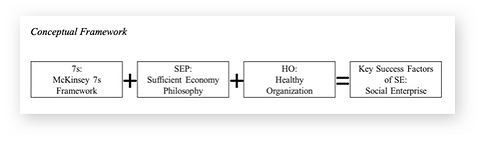

McKinsey's 7s
We decided to apply the McKinsey's 7s Framework to implement the beginning of the Social Enterprise Projects. The 7s includes as following:

Among the seven factors, Shared Value plays a crucial role in maintaining a balance between business development and collaboration. Based on our research, we prioritised identifying solutions to foster shared value within communities, which ultimately led to a structured approach for selecting communities that are prepared for collaboration.

Case Study: Baan Leam Sawan (Community-Based Tourism)
A community-based tourism that applies McKinsey’s 7s for tourism development

Preliminary Phase
Style
The strategic leadership of the head of Baan Leam Sawan
-
Mr. Wannapa Nakoon's strategic leadership focuses on job creation, tourism development, and driving economic and social growth in Baan Leam Sawan by seeking expert support.
Shared Value
CBT with locally authentic experiences
-
Involve villagers in tourism decisions and guide them on promoting and welcoming tourists.
Preparation Phase

Structure
-
Structure: Collect economic, socio-cultural, historical, and environmental data
-
Restructure: Understand village practices and reorganise to align with tourism activities
Staff
Clear task division: each team were suggested/trained by the researchers to make tourism activities at Baan Leam Sawan as professionally as possible
Experimental Phase


Skills
-
Skills data collection: villagers learned data collection (interviews, surveys, observations)
-
Tourism practice skills: site visits & resource management to learn tourism tasks & improve values
Strategy
-
SWOT discussions:
-
Natural & cultural resources exploitation
-
Reduce poverty
-
Lack of tourism facilities & unhygienic conditions
-
Site visit to learn about tourism tasks
-
-
Solution: a draft boat trip package with food & drinks included
Systems
Storytelling:
-
Draw attention by local economic information & historical backgrounds
-
Improve presentation skills for local tour guides
Food & Beverage:
-
Local meal from local ingredients
Tourism activity
-
Feeding animals, diving, making pestles show, processed fish show
Physical arrangement
-
Facilities for tour guides & tourists
-
Safety: travelling by boat/raft
-
Cleanliness: boats/rafts, public toilets, & attractions
Management & coordination
-
Responsibility of authorities who can coordinate with all villagers & make sure tasks are aligned
-
Have an aim to increase the quality of CBT development of Baan Leam Sawan
Evaluation Phase
Systems
Internal assessments:
-
Create a workshop to empower individual capability of tourism practices (hospitality skills, experience, self-confidence)
-
Review the the experiential boat trip: help villagers understand roles & solve problems by themselves
External assessments:
-
Gain feedback from tourists on the quality of boat trips
-
Villagers are able to understand:
-
The social reality of tourism, causes & effects, what to improve, & sense of price of the community

Defining Business Collaboration.
Initiate collaboration between TAGTHAi, accelerator, and the community in building a sustainable community-based tourism
TAGTHAi Key Success Factors Discussion

Co-Creation to Form a Social Enterprise
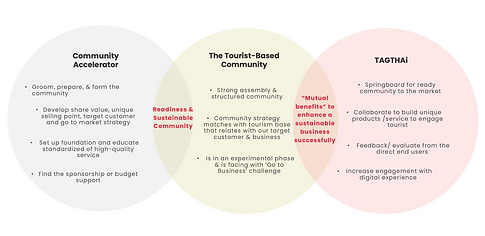
Here, we have showcased the collaboration between stakeholders who will play an important role in building a social enterprise model which include TAGTHAi, community accelerators, and communities (based on the selection criteria).
The Power of Right Stakeholders

From TAGTHAi to Society
Stakeholders of Accelerators

Why do we have an accelerator?
The community accelerators will act as a key person who has expertise in forming a shared value and strengthening the uniqueness of the community. They are the one who helps TAGTHAi build and prepare community to be ready for this sustainable business model.
Here, we have divided the SE project development to 3 stages to identify how we should exactly work on with the communities.
-
Stage 1: find a ready-now community to develop business models together, leveraging their uniqueness as a resource to come up with products & services that can go for commercials on TAGTHAi
-
Stage 2: if some communities are not ready, TAGTHAi would collaborate with community accelerators to groom & mobilise the communities, for example, provide digital/business/entrepreneurship trainings, resources, or guidance so that the community understands their business & roles to be ready for commercialised aspects.
-
Stage 3: apply & enhance digital experience of TAGTHAi to the community to accommodate travellers & improve user experience of local tourism

The frameworks used to strengthen the foundation includes: Business Model Canvas, Design Thinking, McKinsey's 7s, Social Impact Assessment (SIA), Environmental Impact Assessment (EIA), and Theory of Change.

Proposed Implementation Approach
Building on the insights from the previous section, I have identified and aligned TAGTHAi’s value proposition and scope of work with business framework methodologies that support its mission of fostering sustainable community-based tourism.
This section highlights the key resources available to both TAGTHAi and the communities, serving as the foundation for the following development process.


Shared Value Proposition & Business Model for TAGTHAi.
How TAGTHAi can deliver values to the community & customers to drive sustainable growth
TAGTHAi Key Success Factors Discussion
The value proposition of TAGTHAi that matches the community building have been listed out here. The highlighted red sections are the key focus area that has the most possibility for implementation.

The Advantage of Collaboration

TAGTHAi Business Model as a Social Enterprise
From the all processes above, I have come up with the business models that would generate income for TAGTHAi, meanwhile, leverage the sustainable outcome from the community and TAGTHAi collaboration.

‘Only on TAGTHAi’ unique products or services
-
Sell local products that can be found only on TAGTHAi
-
Extra benefits for tourists who visit the community via TAGTHAi

Revenue sharing of products: marketplace model
-
Market shared from products/services, taking percentage of each sell (commission, transaction fee, etc.)

Content generation fee
-
Generate storytelling content on a digital format
-
Provide visibility mechanic of content on platforms (e.g., QR to access local content, VDO clip, etc.)


Income from training courses
-
Locals can take paid online courses/watch paid online clips regarding business direction, skills development, etc.

Business funding model for social impact
-
Social and economic impact justification
-
Create mutual benefits for each business

ESG/CSR activities
-
Create activities related to sustainability to preserve social, economic, cultural, & environmental perspectives (e.g., reduce carbon emission, improve water quality)